Zero Accident Day — CoERS, IIT Madras

Zero Accident Day

A data-driven, people-powered movement for safer roads — led by the Centre of Excellence for Road Safety, with enforcement and mobility partners across India. ZAD is a proactive response to India's road safety crisis: built on data, powered by people, and designed to make safety a shared civic responsibility.

See the campaigns How ZAD works
Zero Accident Day, the film

ZAD in Action

Road accidents continue to be one of India's most pressing public health challenges. In 2023 alone, India reported 4,80,583 road accidents, resulting in 1,72,890 deaths and 4,62,825 injuries. Tamil Nadu accounted for the highest number of accidents, highlighting the urgent need for transformative, community-rooted road safety interventions.

The mission of ZAD is to achieve zero accidents, zero loss, and zero compromise on safety by inspiring collective citizen participation and building long-term behavioural change.

Zero Accident Day directly impacts everyday commuters like parents dropping children off at school, delivery partners racing against time, IT professionals navigating peak-hour traffic, and students walking or riding to schools and colleges.

It is not limited to enforcement or penalties. It invites citizens to be part of the solution through awareness, responsible choices, and emotional connection to safety.

ZAD Launch Zero Accident Day campus launch poster
0road accidents in 2023
0lives lost in 2023
0people injured in 2023
Source: Ministry of Road Transport & Highways, 2023

ZAD Campaigns

City by city, district by district, Zero Accident Day is being adapted to local roads, local risks and local communities. Select a campaign to read how it unfolded.

Tamil Nadu · 20 days

Chennai ZAD

In collaboration with the Greater Chennai Traffic Police, CoERS launched a 20-day campaign focusing on data-driven behavioural change across communities.

Odisha · 23 days

Bhubaneswar ZAD

A statewide campaign launched by the Government of Odisha, engaging thousands of citizens, officials and institutions in a 23-day movement for safer roads.

Odisha · District-wide

Keonjhar ZAD

A district-wide enforcement and awareness campaign inaugurated by the Chief Minister, combining highway enforcement drives with community outreach across all 13 blocks.

Uttar Pradesh · Jul 2026

Ambedkar Nagar ZAD

A district-wide road safety initiative combining engineering improvements, enforcement, education and community participation, led by women road safety ambassadors.
Zero Accident Day: Chennai

Creating Safer Roads in Chennai

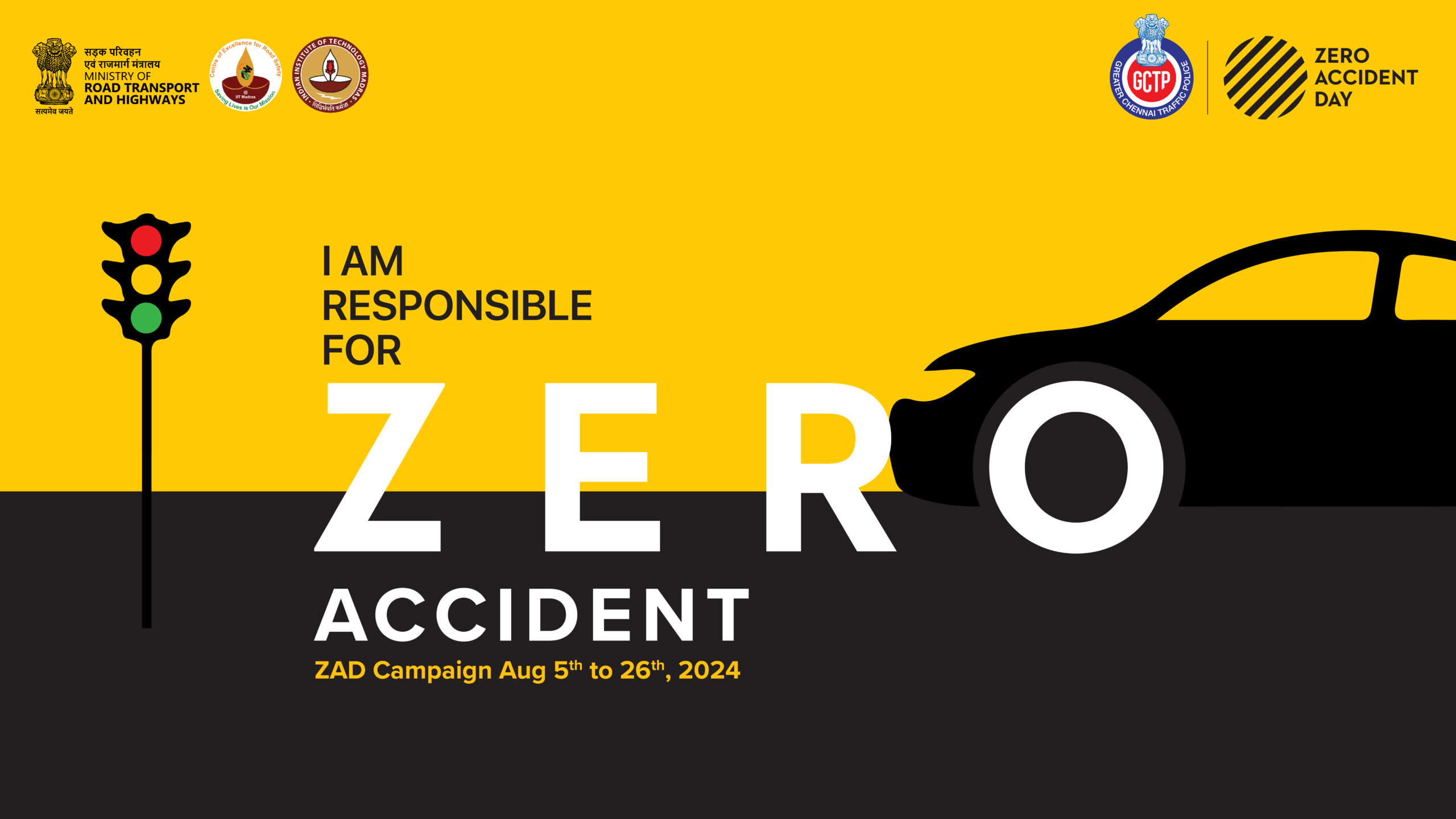
In 2022, Tamil Nadu recorded the highest number of road accidents among Indian states, while Chennai reported 4,291 road accidents. Against this backdrop, the Centre of Excellence for Road Safety (CoERS), IIT Madras, collaborated with the Greater Chennai Traffic Police (GCTP) to launch a 20-day Zero Accident Day (ZAD) campaign focused on improving road safety through research-backed interventions and public participation.

The campaign was inaugurated on August 6, 2024, by Thiru R. Sudhakar, I.P.S., Additional Commissioner of Police, GCTP, at the MTC Headquarters. The event brought together representatives from government, traffic enforcement, academia, and urban mobility to support the shared goal of safer roads.

Built around the principle of "Zero is Good," the campaign encouraged responsible road use and highlighted the importance of preventing accidents and protecting lives.

Educational Initiatives

ZAD focused on building safer road habits among young people through activity-based learning, interactive workshops, and experiential teaching. Awareness sessions were conducted for students, teachers, traffic wardens, and MTC bus drivers to improve their understanding of road safety.

Recognising the importance of driver behaviour, CoERS organised specialised training programmes for MTC bus drivers, food delivery partners, auto-rickshaw drivers, and cab drivers. These sessions addressed the specific road safety challenges faced by different road-user groups and encouraged defensive driving, responsible behaviour, and compliance with traffic rules.

Community Engagement

Community participation was an important part of the ZAD campaign. Activities such as flash mobs, corporate seminars, and creative competitions helped take road safety messages to a wider audience. A reel-making competition also encouraged citizens to create and share road safety messages.

The campaign introduced heart-shaped traffic signals on August 5, 2024, to highlight the importance of empathy on the road. The slogan "Zero is Good" was also displayed through public installations, encouraging conversations about preventing accidents and protecting lives.

Through these activities, ZAD aimed to make road safety more visible and relevant to people's everyday lives.

Emergency Care and First Response

The campaign also highlighted the importance of emergency care following road accidents. First Aid and CPR training programmes helped participants understand how to respond to emergencies and provide assistance when needed.

By combining accident prevention with awareness of emergency response, ZAD promoted a broader approach to road safety that addressed both the prevention of crashes and the importance of timely care.

"The earlier the lesson, the longer it lasts!"

Compliance Days (GCTP)

The campaign included dedicated compliance activities to encourage responsible road use and improve adherence to traffic rules.

  • Helmet Compliance Day: Promoted helmet use through awareness and distribution drives.
  • Signal Compliance Day: Encouraged compliance with traffic signals through awareness and enforcement activities.
  • Stop Line Compliance Day: Focused on stopping at designated lines to improve safety for pedestrians and other road users.

Responsible road users were recognised with ZAD T-shirts, badges, and keychains to encourage positive behaviour and reinforce the importance of following traffic rules.

A Data-Driven Approach to Road Safety

ZAD used crash data insights to identify high-risk road-user groups and guide targeted interventions. The campaign placed particular emphasis on helmet use, defensive driving, and responsible riding, while tailoring educational activities to different age groups and professions.

By bringing together education, enforcement, emergency care, and public participation, CoERS and GCTP worked towards making road safety a shared responsibility.

ZAD is an important step towards building a lasting culture of road safety in Chennai. Its focus on awareness, responsible behaviour, and targeted interventions supports the broader goal of reducing road accidents and protecting lives.

Zero is Good. Every journey should end safely.

Zero Accident Day — Bhubaneswar

When Empathy Became Governance

Across India, where more than 1.68 lakh lives are lost in 2022 due to road accidents according to Ministry of Road Transport and Highways (MoRTH), Odisha's Zero Accident Day (ZAD) 2025 campaign has emerged as a nationally relevant model of empathy-driven governance. In Bhubaneswar, the capital city, ZAD reimagined road safety not as a compliance measure but as an emotional social movement — a campaign that turned data into dialogue and citizens into changemakers.

At its core was a simple, moving philosophy: #ComeHomeSafe — a reminder that every rule followed, every helmet worn, and every speed limit observed carries one human goal: someone waiting at home.

"Every pledge, every poster, every act echoed one reminder — the family waits for you."

A Vision that Began with a Promise

The campaign was launched on June 3, 2025, at Loka Seva Bhavan, Bhubaneswar, by Hon'ble Chief Minister Shri Mohan Charan Majhi, whose call to action resonated across Odisha's districts. His message was clear — every journey must end in safety.

From that moment, ZAD evolved from a government programme into a Jan Andolan — a people's movement. Over 9 lakh citizens engaged through roadshows, community drives, and digital pledges. Within 23 days of the campaign, the data reflected a transformation of measurable and meaningful outcomes.

Women at the Moral Centre

The campaign's moral centre was deeply women centric. If the message of #ComeHomeSafe carried emotion, it was the women of Odisha who gave it soul. The campaign's mascot "Surakshya", depicted as a woman holding a kalash of protection, symbolised care personified. She became the moral centre of ZAD — the embodiment of the promise to protect as a mother protects her children. Her presence was everywhere — in posters, pledge ceremonies, and community workshops, a quiet yet commanding reminder of what surakshya meant. She was the conscience of a city learning to protect its own.

Women's Self-Help Groups (SHGs) and road safety committees became key mobilizers. They led awareness drives in residential colonies, encouraged helmet compliance within families, and conducted peer-learning sessions in local markets and schools. This women-centric approach reframed road safety through emotional economics — where the value of a life extended beyond statistics into social wellbeing.

Events that Moved the City

Bikash Mela (Civic Expo) became a festival of awareness, where families queued to take selfies with Surakshya, children wrote promises on the pledge wall, while volunteers distributed helmets as tokens of encouragement, and citizens took the #ComeHomeSafe oath.

Padma Shri Sudarsan Pattnaik's sand art at Puri Beach, reading "No Mistake, No Loss", stood as an emotional emblem of the movement which has turned art into advocacy. Each artistic gesture carried scientific purpose; each policy measure carried human depth.

Municipal workers paused their morning shifts to take the #ComeHomeSafe pledge, while police officers conducted "zero tolerance" drives that combined strict enforcement with acts of encouragement, offering helmets, flowers, and thank-you notes to safe drivers. Bus drivers, too, joined symbolic pledge ceremonies, where helmets and flowers replaced fines — turning enforcement into empathy.

Human Science Meets Policy

ZAD Bhubaneswar's greatest achievement lay in its fusion of engineering precision and emotional intelligence. Initiated by RBG Labs, IIT Madras with support of the Commerce and Transport Department, the campaign used behavioural insights, real-time data, and empathy-led design to build compliance through culture.

It shifted road safety from an enforcement lens to a citizen co-created governance model. The ZAD campaign became a social laboratory: an experiment in how policy can touch hearts — proving that enforcement alone cannot succeed without empathy.

"Zero Accident Day redefined safety as a shared responsibility between data and conscience."

Zero Accident Day 2025 — Bhubaneswar stands today as India's living proof that road safety is not only a matter of law, but of love — a moral contract between roads and users, between governance and empathy, between every departure and every safe return.

#ComeHomeSafe — because every journey deserves an ending called home.

ZAD — Keonjhar

The Living Laboratory of Empathy, Enforcement & Engineering

The Zero Accident Day (ZAD) 2025 campaign in Keonjhar emerged as a landmark initiative — an experiment in combining enforcement, empathy, and engineering. As the first district to operationalize Odisha's new road safety vision, Keonjhar became a living laboratory of behavioural change, data-driven governance, and civic participation. Guided by the principle #ComeHomeSafe, the campaign redefined safety not as a regulation but as a shared emotional responsibility between citizens and the state.

Launched by Hon'ble Chief Minister Shri Mohan Charan Majhi, the 14-day campaign united the district administration, enforcement agencies, IIT Madras researchers, and local communities under one mission to make Keonjhar a model of safe and humane mobility. The message was profound in its simplicity: every safe journey is a promise fulfilled to someone waiting at home.

The campaign opened with a collective pledge for safety at the Keonjhar District Headquarters. Dignitaries from the Transport Department, Police, and local leadership joined citizens in committing to a safer future. The Chief Minister's declaration, "Safety is a social responsibility, not a regulation," captured the essence of the movement. Adding symbolic depth, the "Banyan Road Safety Tree" became a living monument of protection and hope. Citizens tied handwritten pledges reading Come Home Safe, creating a visual representation of shared accountability. Recognition of Good Samaritans who helped accident victims highlighted compassion as the moral foundation of governance.

Driver-Centric Interventions: Awareness as Empowerment

Recognizing that drivers form the heartbeat of Keonjhar's transport ecosystem, ZAD placed them at its centre. The Hatare Batare Ghatare Charcha — an innovative night-time engagement model developed with IIT Madras and RBG Labs — transformed late-night checks into human-centred dialogues. Officers and IIT teams met drivers at Khireitangiri and Kandara Toll Gates, sharing tea and meaningful conversations under the glow of highway lights.

Discussions revolved around fatigue management, safe speed, defensive driving, and the Raahveer initiative, which encourages citizens to help accident victims responsibly. For many, it was the first time enforcement had "listened" to them — a shift from inspection to connection.

Education and Community as Catalysts

Training programs at the Institute of Driving Training and Research (IDTR), Dhanurjayapur, and workshops in Joda's mining belt reached over 200 professional drivers, focusing on defensive driving, risk perception, and behavioural safety. Parallel programs in schools and colleges, including Lakshmi Narayana Degree College (Ghatagaon), educated youth on the Good Samaritan Law and responsible commuting.

"Every pledge, every class, every roadside conversation carried one message — come home safe."

Community sessions in Bayapandadar near Gonasika, a high-accident zone, equipped locals with hands-on training in first response, golden hour aid, and emergency protocols — turning awareness into action.

The Keonjhar Model: When Empathy Scales

By the campaign's end, Keonjhar had delivered a replicable model of safety governance: one that blends behavioural psychology, engineering design, and human connection. From the banyan tree of pledges to the radio waves of empathy, the district proved that sustainable safety arises not from fear, but from trust, awareness, and shared purpose.

#ComeHomeSafe is a call for covenant between the road and the home, between the state and the people, between every departure and every safe return.

All India Radio Interview Excerpts

As part of the Zero Accident Day (ZAD) campaign, All India Radio (AIR), Keonjhar played a pivotal role in taking the message of road safety beyond highways and into people's homes. Through a series of five special radio broadcasts aired between 17 and 25 September 2025, AIR transformed everyday listening into a platform for awareness, learning, and reflection.

The talk shows featured distinguished speakers, including Transport Commissioner Shri Amitabh Thakur, Prof. Venkatesh Balasubramanian and Principal Project Officer Shri Gangadhar Sahoo from RBG Labs, IIT Madras, Dr. Tanmay from the District Hospital, Keonjhar, and RTO Keonjhar Shri Manas Ranjan Sahoo. Together, they discussed critical road safety themes such as the vision of the Zero Accident Day initiative, the Good Samaritan Law, Golden Hour response, medical preparedness, youth awareness, and the importance of community participation in preventing road accidents.

The discussions struck a balance between data and empathy, making technical concepts accessible and relatable for listeners from all sections of society. A deeply moving moment came when a road accident survivor shared a personal story of survival and recovery. This testimony powerfully reminded listeners that behind every statistic is a life, a family, and a community — and that road safety is not just about rules, but about responsibility and compassion.

The radio series reached households across Keonjhar and neighbouring regions, creating meaningful awareness in both urban and rural communities. Listener feedback reflected strong appreciation for the way expert insights were connected to real-life experiences.

In essence, the All-India Radio Road Safety Talk Series became more than a broadcast — it emerged as a shared conversation on caution, care, and collective responsibility. Through sincere dialogue and human stories, the initiative reinforced a simple yet powerful message: road safety begins with awareness, and every safe journey brings Odisha closer to the goal of Zero Accidents.

Zero Accident Day (ZAD) Campaign

Ambedkar Nagar · 7–21 July 2026

Making Road Safety a People's Movement

Road crashes are not inevitable — they are preventable. Every road crash affects not just an individual, but an entire family and community. The Zero Accident Day (ZAD) Campaign is built on a simple yet powerful belief: every road user deserves to return home safely.

The Zero Accident Day (ZAD) Campaign is a district-wide road safety initiative being implemented by the District Administration, Ambedkar Nagar, with technical support from the Centre of Excellence for Road Safety (CoERS), IIT Madras, under the Data Driven Hyperlocal Intervention (DDHI) programme supported by the Ministry of Road Transport and Highways (MoRTH).

ZAD goes beyond awareness campaigns. It combines data-driven engineering improvements, community participation, behaviour change, enforcement, education, and capacity building to create safer roads and safer road users. The campaign draws upon successful learnings from interventions in Tamil Nadu and Odisha, adapting them to the local context of Ambedkar Nagar.

A Community-Led Road Safety Movement

One of the defining features of the campaign is the active participation of the community — particularly women. Thousands of Sadak Suraksha Sakhis (SSS) have been trained to become road safety ambassadors within their villages and neighbourhoods. Through door-to-door outreach, family conversations, and community engagement, they encourage safer road user behaviour and promote responsible mobility practices.

The campaign also brings together students, youth, teachers, drivers, transport stakeholders, local bodies, government departments, civil society organisations and the media, reinforcing that road safety is a shared responsibility.

"When government institutions, communities and citizens work together, safer roads become possible."

Key Highlights of the Campaign

Throughout the campaign, Ambedkar Nagar will witness a series of integrated road safety initiatives, including:

  • District-wide launch led by the District Administration with a road safety pledge
  • Community outreach by Sadak Suraksha Sakhis through door-to-door awareness campaigns
  • Training and certification of Sadak Suraksha Mitras
  • Official launch and handover of seven Black Spot Audit Reports prepared by CoERS, IIT Madras, along with the inauguration of engineering safety improvements
  • School and college road safety pledge campaigns and awareness activities
  • Gram Sabha-based road safety chaupals and citizen engagement
  • Driver wellness camps with eye check-ups, fatigue management and blind-spot awareness
  • Reflective tape distribution for bicycles, tractors and e-rickshaws
  • Special traffic enforcement drives promoting helmet use, seat belts, speed compliance and responsible driving
  • Digital outreach showcasing community participation and campaign impact

The Vision

Zero Accident Day is not limited to a specific date or campaign period. It is a vision to make safe road behaviour a daily habit and a collective responsibility.

When government institutions, communities and citizens work together, safer roads become possible.

Because the true success of road safety is when every journey ends with someone returning home safely.

Press Esc or tap outside to close